Study: Customer experience drives choice of primary bank in Brazil

Customer experience has become the most important factor determining which bank Brazilians choose as their primary financial institution, regardless of their income or financial profile. This is one of the key findings of a survey by Bain & Company.
The research examined the factors that influence customers to concentrate their financial relationships with a single bank, finding that each customer type has its own combination of needs and behaviors, influencing the products and services that matter most when choosing a primary bank.
However, one factor stands out across all ten segments: relational Net Promoter Score (rNPS), which measures customer loyalty and satisfaction with a bank based on the overall relationship. Its impact ranges from 13 percentage points among high-income customers to 24 percentage points among low-income self-employed customers.
The findings suggest that banks cannot rely on standardized strategies to attract and retain customers. “This context explains why standardized strategies tend to limit the ability of banks to expand market share and engagement with consumers,” says Silvio Marote, a partner at Bain & Company.
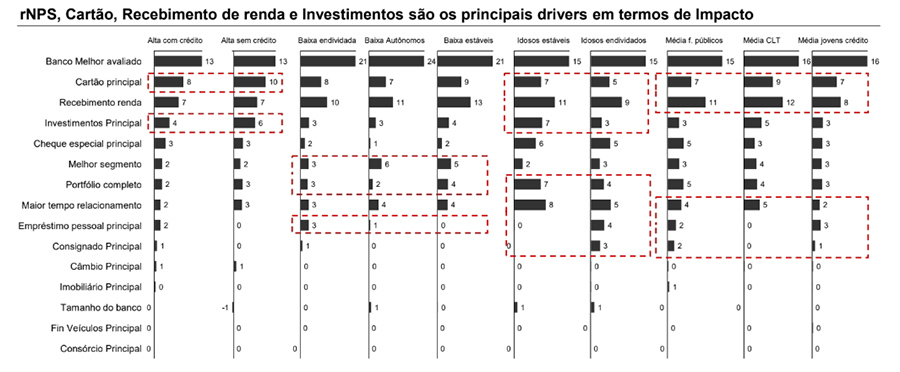
The research also highlights differences in how customers evaluate their primary and secondary banks. The gap in ratings is considerably wider among low-income customers, while competition between banks is more balanced among wealthier consumers.
Beyond customer experience, product preferences also vary by segment. Credit cards remain an important factor across income groups, contributing between 7 and 10 percentage points to a bank’s position as a customer’s primary institution. Investments carry greater weight among customers with higher wealth accumulation capacity and stronger financial health, where their impact reaches 6 to 7 percentage points, compared with around 3 points in most other segments.
The differences are also evident between traditional and digital banks. Credit cards have up to three times the influence on banking primacy at digital banks, accounting for 15 to 20 percentage points, compared with 8 to 10 points at traditional institutions. By contrast, relationship length and the use of overdraft facilities are more closely associated with traditional banks.
Digital channels are another common feature across customer groups. Banking apps are the main point of interaction in every segment analyzed, making the quality of the mobile experience an essential part of customer retention and engagement.
Key takeaways
For banks in Brazil, Bain & Company said the findings point to the need for more targeted customer strategies, combining relevant products with consistent service and personalized interactions. “Banking primacy depends on delivering value throughout the customer journey,” explained Marote.
“Institutions that adapt their offers and interactions to different customer needs are better positioned to deepen relationships, increase engagement and capture a larger share of financial activity.”